Christiana Myers is a History of Art PhD student at the University of Glasgow studying the use of epidemiological metaphor and viral symbolism in contemporary art in the years following the Covid-19 pandemic. Her curatorial and writing practice, primarily based in Canada, are often driven by interdisciplinary interests and explore physical, environmental, or institutional systems.
Viral Communication was a research-creation project that explored notions of contagion across visual culture, social dynamics, and medicine in an era informed and influenced by a pandemic. The event comprised a one-day interdisciplinary workshop complemented by a week-long exhibition of contemporary artwork.
The workshop brought together 15 researchers from sectors including contemporary visual art, art history, virology, and the history of medicine to encourage interdisciplinary knowledge exchange surrounding notions of the Covid-19 virus as well as others. In order to prioritise curiosity over conclusions, and exploration over expertise, the workshop utilised curatorial methodologies such as a conversational panel discussion with featured speakers, an artist talk, and collaborative visualisation and critical analysis activities.


The day began with a panel discussion featuring four speakers to explore the multifaceted intersections of disease, art, and metaphor: Sophie Goggins, Senior Curator of Biomedical Science at National Museums Scotland; Stephen Devlin, a virologist and PhD student at the University of Glasgow; Debra Strickland, Professor of Medieval Art History at the University of Glasgow; and Rae-Yen Song, an artist and curator based in Glasgow. The conversation delved into historical and contemporary perceptions of disease, the symbolic power of language, and the role of museums in shaping public understanding. They discussed how crises are documented through objects and images, and the importance of rethinking narrative metaphors. Themes included the mythological framing of disease, the impact of semiotics in science communication, and the cultural implications of artistic representations from the Black Death to modern biomedicine.

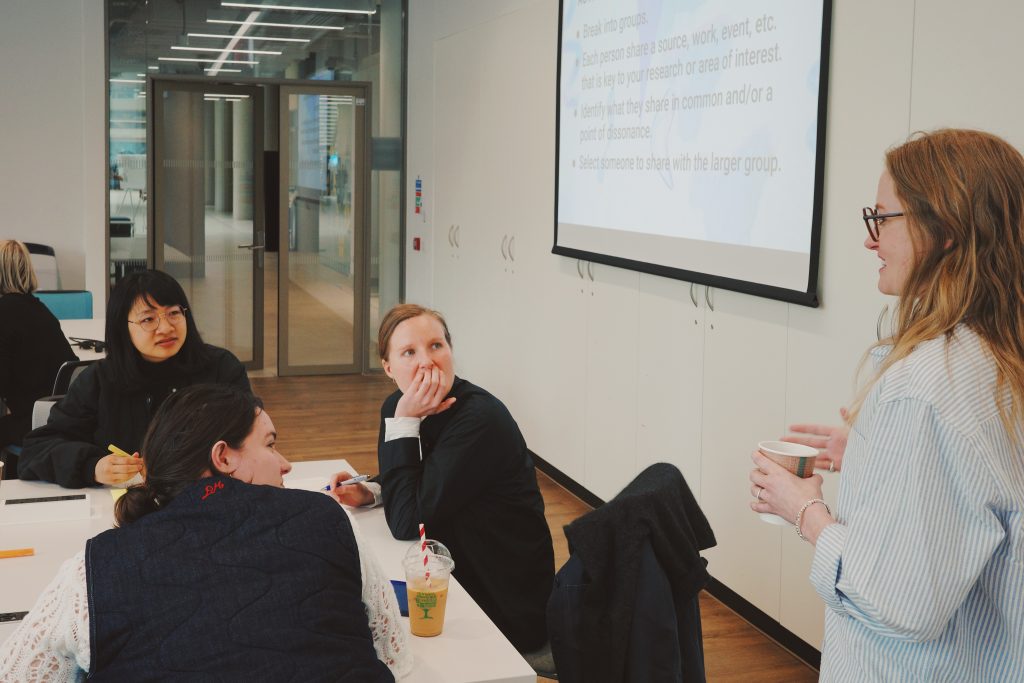
As each participant had a tie to the workshop’s subject matter, the second activity was to build a shared bibliography of literature and case studies key to the variety of research areas. In groups, each participant shared a source, work, event, etc. that was key to their interests. Each group identified commonalities within their recommended sources before sharing with the wider group. Themes that emerged included public health and community, language that kills, and under the skin. These sources then became the foundation for a mind-map that connected the many themes and metaphors as they arose throughout the day.


In the afternoon, Belladonna Paloma, an artist based in Shetland whose work was featured in the project’s exhibition component, presented an artist talk. She spoke to the works included in the exhibition, titled The universe is a block of cheese and the worms are angels, which was installed in the foyer of the Advanced Research Centre at the University of Glasgow.


Featuring two bodies of work, Grief Cards (2021) and Descent to Kilgrimol Rx (2022), the exhibition tapped into the slippery space between magic and reality where illness has been known to float freely. Passage through these interstitial networks is common in Belladonna Paloma’s art practice as she creates opportunities for legend and myth to bubble together with histories and embodied experience. Through methods including Tarot, drawing, and painting, she asks after established meanings—and divines new ones—illustrating scenes from the pulsating, undulating, and rupturing plane between the biological body and metaphysical belief.


We acknowledge the support of the Canada Council for the Arts.

